
About
In 2025, the University of Arkansas engaged Huron Consulting to take an in-depth look at how IT is organized, funded, and delivered across campus.
Over several months, they gathered input from across the university—conducting interviews and focus groups with more than 50 stakeholders and collecting responses from 283 IT staff through a skills survey.
What they heard confirmed something many already recognized: the University has talented, dedicated technology professionals delivering strong support every day. At the same time, much of this work happens within separate units, and the structures meant to connect and support it have not kept pace with the university’s growth and evolving needs.
Principles guiding the work
This effort is guided by a set of principles that reflect both campus priorities and the realities of how IT operates today:
-
Federated, not centralized
UITS will continue to support shared, enterprise services, while colleges and units retain meaningful IT capacity aligned to their missions. -
Transparent and consultative
Major decisions will be informed through established governance processes with campus representation—not made in isolation. -
Build on strengths
The assessment identified a highly adaptive workforce and deep institutional knowledge as key strengths. This work is designed to preserve and strengthen them. -
Service-first
Faculty, staff, and students should experience IT as one university—with a clear path to get help and consistent, predictable service. -
Research-aware
As an R1 institution, the university has complex and specialized research needs. This model includes dedicated support and advisory input for Research IT. -
Deliberate pace
Significant changes to funding and structure are not immediate. Planning, communication, and preparation will take place over time, with major changes targeted for FY28 and beyond.
Project Focus Areas
This initiative is organized around three core focus areas:
IT Strategy & Governance
IT Resource Model
IT Services & Technology
What this Means to You
For Faculty, Students, Staff, and Unit Leaders
The goal of this work is to create a more consistent and reliable IT experience across campus. In practice, this means:
- A clear path to get help. A single place to request support, report issues, or submit projects—replacing today’s mix of forms, email aliases, and ticketing systems.
- More predictable service. A published service catalog with clear response and resolution expectations, so you know exactly what to expect.
- Local support remains in place. Colleges and units will continue to have IT staff aligned to their specific needs. This federated model is not a top-down centralization.
- A stronger voice in priorities. Governance groups will include faculty, research, administrative, and student perspectives to help guide decisions.
- Improved continuty and resilience. Expanded disaster recovery efforts will focus first on the systems most critical to your work.
For IT Staff: UITS and Unit-Based IT Colleagues
This initiative is focused on improving how IT work is organized and supported across campus—not eliminating roles.
- This project is not about eliminating your role. The focus is on realigning how IT work is organized and supported across campus. The University does review positions from time to time as part of normal operations — that's not new, and it's separate from this effort. If anything changes that affects you, you'll hear it directly and won't be left to wonder.
- A deliberate pace for change. Significant changes to the operating model and funding structure are planned for FY28 and beyond, wtih time built in for planning, communication, and training.
- Improved tools and systems. A consolidated service-management platform replaces the patchwork of legacy systems, ClickUp, Excel and others used across the institution.
Timeline
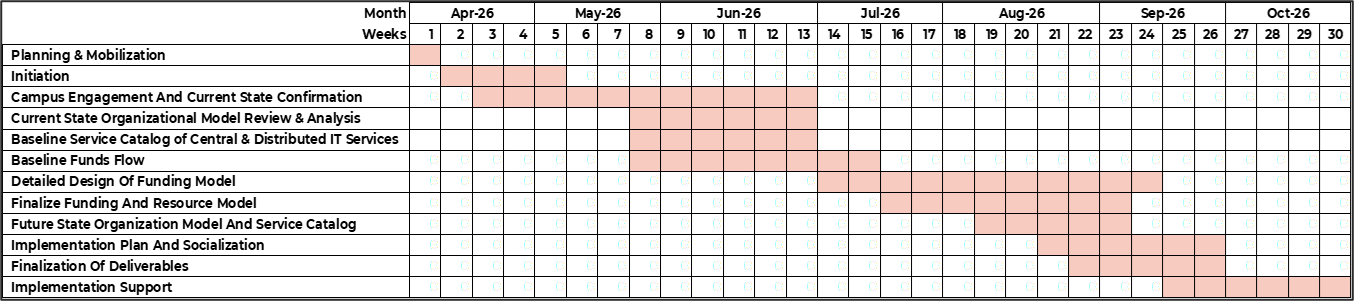
The initial project work will span about 7 months, with Huron and our Working Groups. From there, we will be doing a 2 year phased implementation of recommendations that come from this initial work phase.
FAQ
Answers to common questions about the University of Arkansas IT Modernization initiative, including technology upgrades, system improvements, cybersecurity, cloud services, and campuswide digital transformation efforts. Explore how IT Services is enhancing connectivity, collaboration, and support to create a more secure, efficient, and modern technology experience for students, faculty, and staff.
The University of Arkansas was benchmarked against a group of peer institutions, including several SEC universities. Personnel data was also reviewed internally to help ensure accuracy and alignment with with campus structures.
The goal of the IT Modernization project is to establish a future-state IT operating
model that better supports the needs of the University of Arkansas.
This includes developing a clearer understanding of how IT services are delivered,
funded, and supported across campus, along with identifying opportunities to improve
efficiency, coordination, and service quality over time.
The initiative is not a workforce reduction effort.
Like any large organization, the University periodically reviews staffing as part of normal operations — and that will continue to be true independent of this project. Leadership is committed to communicating openly about both, and you won't be left guessing about what's happening or why.
In a centralized model, one IT organization makes most of the decisions — about tools, staffing, support, and priorities — for the entire institution. It's efficient, but it can feel slow and disconnected from the needs of individual colleges and units.
In a federated model, central IT continues to provide shared services such as infrastructure, security
and enterprise systems, while colleges and units retain local IT staff to assist in
their local needs and directives.
This approach is designed to balance consistency across campus with flexibility at
the unit level.
Possibly — but no decisions have been made at this time.
Over the next several months, university leadership will engage stakeholders across administrative, academic, research, and IT functions to better understand current needs and opportunities . Any changes will come out of that process — not from a predetermined plan.
Opportunities for involvement will be shared through university communication channels as the initiative progresses.
Please continue to check this website for updates, including ways to participate and provide input.
IT Modernization refers to a coordinated effort to improve how technology supports the university's teaching, research, and administrative work.
This includes evolving systems, processes and service delivery approaches to create a more efficient, reliable, and sustainable IT environment.
While timelines will be revised over time, initiatives of this scale typically take place over multiple years, with planning underway now and major implementation efforts expected to begin in FY28.
All documents are being held in a SharePoint located on the IT Intranet. Check back regularly for more information!
Decision Making Process & Campus Engagement
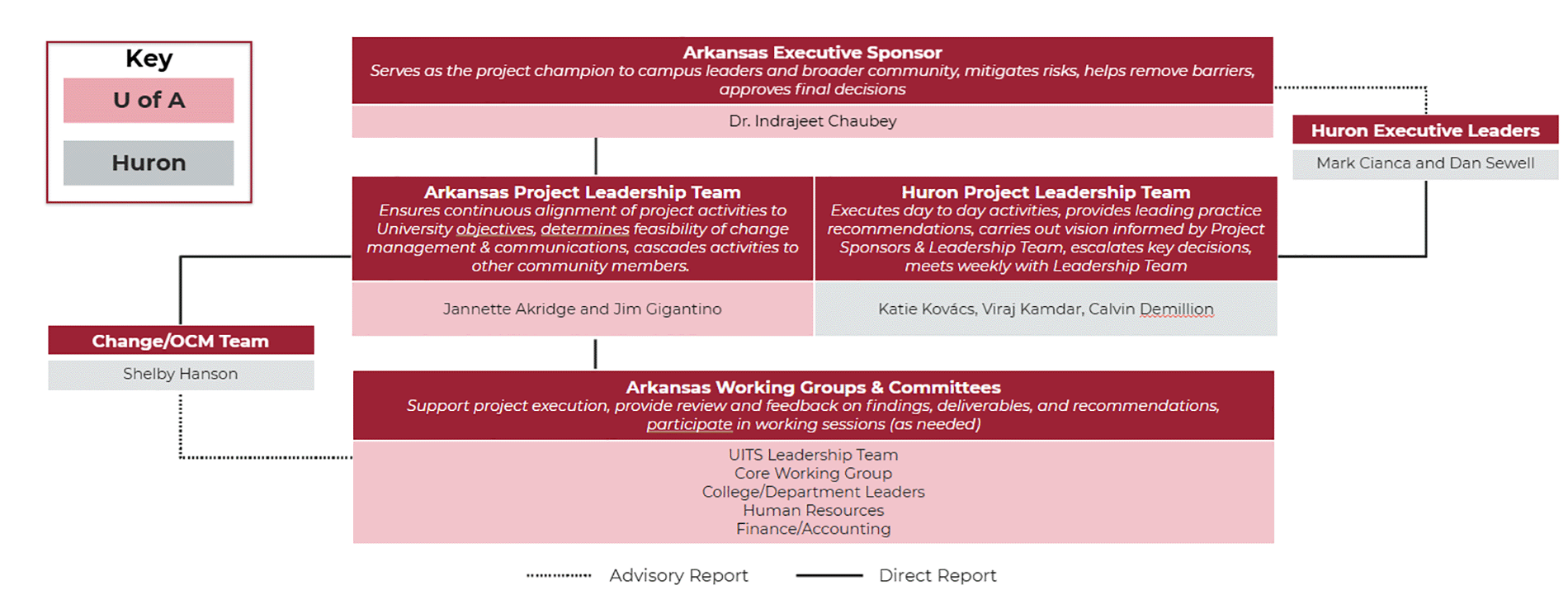
The Huron team proposes a governance structure comprised of engagement sponsors and project leaders to inform decision making. Broader campus community members will be engaged appropriately as needed.
Campus Committees
Topics to Discuss:
- Reassess challenges and opportunity areas to co-create the future-state vision for IT
- Evaluate existing service delivery expectations and outcomes within the Schools and Colleges
Members:
- Dr. Indrajeet Chaubey
- Chris Lee
- Selena Hriz
- Kathryn Zawisza
- Bryan Hill
- Gary Peters
- David McNabb
- Cheryl Murphy
- Paul Calleja
- Jeremy Battjes
- Cale Fessler
- Ann Gearity
- Chris Butler
- Becca Clifton
- Terry McDowell
Topics to Discuss:
- Explore what people, processes, and technologies are managed by the campus unit and how they are funded
- Understand current SLA/OLA and service delivery expectations
- Catalog and assess IT services, technology platforms, and existing tracking capabilities
- Evaluate opportunities for standardization and improved financial stewardship
- Validate current and future state funding model
Members:
- Shaila Miranda
- Teresa Waddell
- James Martin
- Jessica Morales
- Jamie Loftin
- Dave Dawson
- Matt Sparks
- Terry White
- Chris Butler
- Chris Nixon
- Mike Oestereicher
Topics to Discuss:
- Understand current IT funding sources and uses
- Define basic services
- Identify how IT services are funded
- Examine current IT billing systems
Members:
- Chris Frala
- Ann Gearity
- Jordan Fundermann
- Bryan Adams
- Jack Dennis
- Amie McClendon
- Colleen Briney
- Paul Soulsby
- Lakshmi Thyagarajan
- Angie Coleman
- Brandi Maples
- Jeffie Thomas
- Jamie Loftin
- Larry Esch
- Rachel Whitman
- Marco De Prosperis
- ME Armstrong
- Melissa Erwin
- Mike Bieker
- Tanya Russell
- Jackie Micheletto
- Craig Tigges
Topics to Discuss:
- Evaluate federated organization structure considerations and reporting
- Review of workforce transition strategies
- Discuss standardized job architecture & roles
- Possibly engage employee relations for change management
Members:
- Amy Ochoa
- Wallison Domingues
- Eva Cordero